
Ancient Culture in a 'Modern' World
Ancient Culture in a 'Modern' World
On Ayahuasca, religious freedom, and a conversation Australia needs to have
By the Grace of Great Spirit,
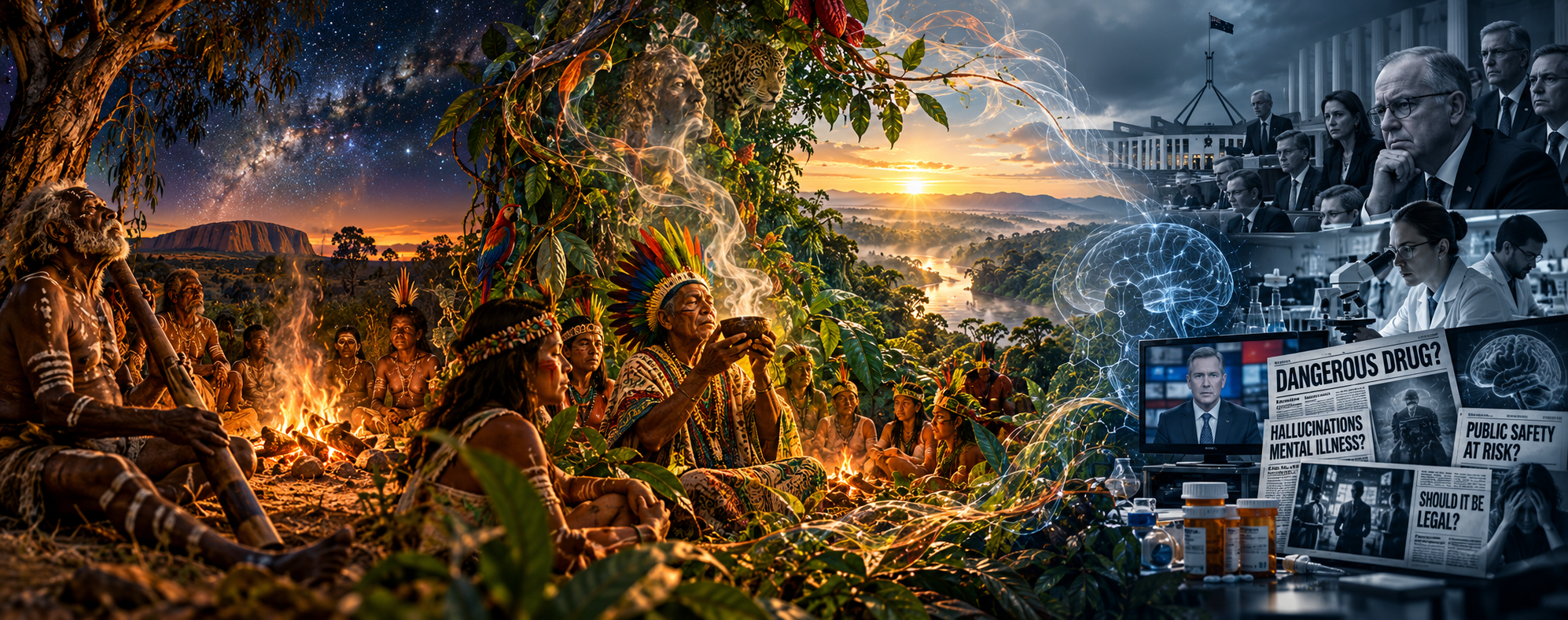
Ayahuasca is not new. It's an ancient sacrament that has been used ceremonially for thousands of years by indigenous peoples of the Amazon basin in South America, held sacred by communities whose knowledge of and relationship with plant sacraments predates any modern legal framework by millennia.
During the last 50 years, governments and courts around the world have come to recognise this. The United States Supreme Court has upheld the right of religious communities to use Ayahuasca in ceremony. The Brazilian government has formally protected it as a sacrament. Canada and other nations have followed. Many references are provided at the end of this blog post. These decisions were not made casually — they were made after rigorous examination of the evidence, the traditions, the safety data, and the human rights dimensions of criminalising sacred practice.
Australia has taken a different path. Here, these Holy sacraments are prosecuted as 'dangerous drugs' — despite overwhelming volumes of scientific and medical research demonstrating their relative safety in ceremonial and therapeutic contexts. Despite explicit indigenous support for these traditions and their deep connection to living indigenous culture and spirituality. Despite the fact that the United States Supreme Court, among others, found no significant risk in their sacramental use. And despite the fact that first nations peoples accross Australia have been partaking in plant sacrament ceremonies for aeons, with plants that have the same characterisitics and chemical constituents as Ayahuasca.
The 2023 ICEERS report estimated that over four million people across America, Europe, Australia and New Zealand have taken Ayahuasca in their lifetime — a global community whose voices and experiences deserve to be part of this conversation. These are not fringe communities, they are people seeking healing, spiritual connection, and a relationship with wisdom traditions that belong to all of humanity. These plant sacraments and the culture that hold them are sacred gifts bestowed upon humanity from Great Spirit, from creation. Cultural erasure and silencing is not an ethical, moral nor acceptable path for a modern society.
Australia has not yet followed the path taken by the United States, Brazil, and Canada. That divergence matters — in the scientific community, in conversations about religious freedom, and in the wider question of how this country chooses to engage with indigenous spiritual traditions and the people who hold them sacred.
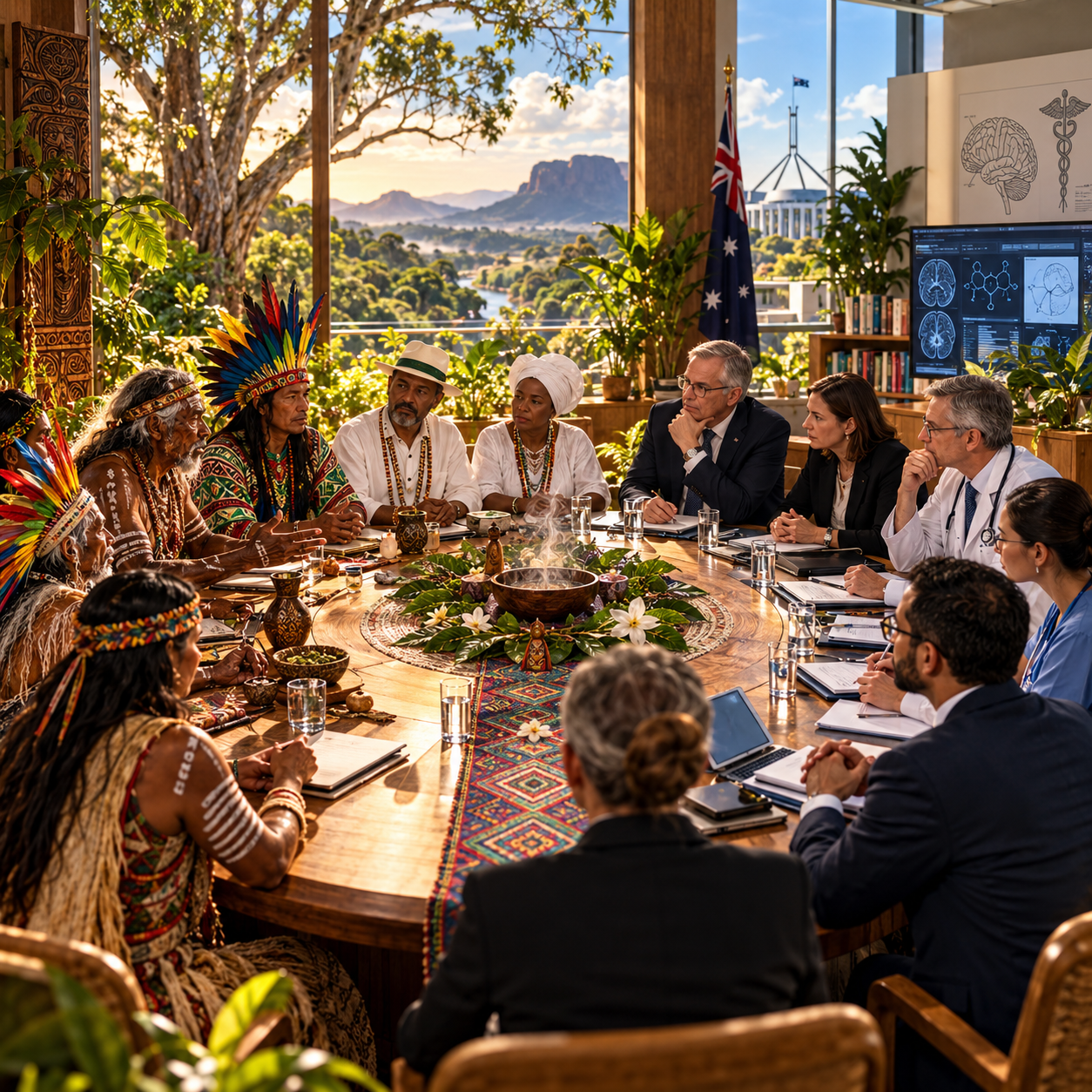
My hope is that as this conversation matures in Australia, those who engage with it do so with the depth of inquiry that these traditions — and the communities who hold them — deserve. The relationship between ancient ceremonial practice and modern legal frameworks is genuinely complex. It calls for respect, curiosity, humility, and a willingness to examine the full body of evidence: historical, cultural, scientific, and human. In time, I intend to write in much greater detail about what this process has taught me about that relationship, and share my ideas about what a wiser path might look like.
"Most people cannot see past the horizon of their everyday lives, and so base their judgments on the conditioned limitations of what occurs — and what they accept as real — within this everyday horizon. But there are some who see beyond this horizon to the Light of Eternity, and so base their judgments on the Eternal verities.
”It is no surprise that those who abide by the Eternal are often at variance with the everyday norm, and so are continually challenged to remain true to what they know. This is the eternal saga of those who possess vision: they are often deemed outcasts by the majority, who will always try to make the Eternal and the Infinite conform to the finite and the conditioned."
— José Argüelles / Valum Votan - The Unpublished Journals
I am a spiritual practitioner, artist, musician and an author. What I'm living through isn't separate from the book I wrote, but a continuation of it. The questions this moment raises about freedom, about dignity, about whose sacred practices deserve respect and protection, are not questions for me alone. They belong to every person who has ever found healing in a tradition that sits outside the mainstream. To every community that holds ceremony as sacred. To anyone who believes that justice should be blind to what you consider Holy.
Way of the Hummingbird book is full of revelations and positive stories for the healing and evolution of the planet. This blog will continue that story — and continue to be a voice for ethical and spiritual development for the people of the Earth.
Follow this space. This conversation matters.
Further Reading and Sources
The claims made in this post are grounded in a substantial body of peer-reviewed science and established legal precedent. A selection of the key sources is listed below. The full reference guide — covering the complete scientific literature, the legal decisions, and the research programmes referenced here — is available in the following post.
The US Supreme Court Decision
Gonzales v. O Centro Espírita Beneficente União do Vegetal, 546 U.S. 418 (2006)
Unanimous ruling upholding the right of a religious community to use ayahuasca as a sacrament.
Full decision: US Supreme Court ruling Ayahausca religion freedom
Brazil — Government Regulatory Framework
Ayahuasca formally authorised for religious and ceremonial use since 1987. Strengthened by CONAD Resolution 01/10 in 2010.
ICEERS legal overview: ICEERS Legal report - Brazil
CONFEN — Federal Council of Narcotics, Brazil (1987)
The Brazilian government's own investigation — two years of fieldwork, community visits, and direct participation in ceremonies — concluded in 1987 that ayahuasca's ceremonial use brought no harm to society and contributed to the better integration of those who used it. This conclusion was confirmed unanimously in 1992 and has formed the foundation of Brazilian law ever since.
The investigation was notable for its rigour — the working group's lead counsellor, Dr Domingos Bernardo Gialluisi da Silva Sá, personally participated in a ceremony as part of his research, a detail that speaks to the seriousness with which the Brazilian government approached the question.
Full account of CONFEN proceedings: https://spiritvineretreats.com/ayahuasca/brazilian-law-regarding-ayahuasca/
1987 conclusion in direct quotation: Brazil | CONFEN Ayahuasca government conclusion
Canada — Health Canada Religious Exemptions
Section 56 exemptions granted to Santo Daime and UDV churches from 2017. Six organisations hold formal legal protection as of 2020.
ICEERS legal overview: ICEERS Legal report - Canada
The Hoasca Project (1993–1996)
Grob CS, McKenna DJ et al. Human Psychopharmacology of Hoasca, A Plant Hallucinogen Used in Ritual Context in Brazil. Journal of Nervous and Mental Disease, 1996.
The foundational biomedical study of long-term UDV members. Led by UCLA and an international consortium. No toxicity, no cognitive impairment, higher cognitive test scores than matched controls. The study that informed the US Supreme Court.
PubMed: Hoasca Project - Pub med
Spanish Santo Daime Studies
Bouso JC et al. Personality, Psychopathology, Life Attitudes and Neuropsychological Performance among Ritual Users of Ayahuasca: A Longitudinal Study. PLOS ONE, 2012.
127 ritual users in Spain assessed at baseline and one year later. No psychological maladjustment, no mental health deterioration, no cognitive impairment. Users outperformed matched controls on cognitive tests.
Full text (open access): https://journals.plos.org/plosone/article?id=10.1371/journal.pone.0042421
Bouso JC et al. Personality, Not Cognition, Distinguishes Chronic Ayahuasca and Cannabis Users from Non-Users. ICEERS / Universitat Rovira i Virgili, 2026.
Most recent Spanish research. Members of the Spanish Santo Daime Church. No cognitive differences detected between long-term users and matched non-users.
ICEERS: ICEERS Santo Daime studies
The Global Ayahuasca Project — University of Melbourne
Led by Dr Daniel Perkins, University of Melbourne. The largest scientific study of ayahuasca drinking ever conducted — over 10,800 participants from more than 50 countries.
Perkins D et al. Associations Between Ayahuasca Use in Naturalistic Settings and Mental Health and Wellbeing Outcomes: Analysis of a Large Global Dataset. Journal of Psychoactive Drugs, 2024.
7,576 participants. Greater frequency of ceremonial use associated with improved psychological wellbeing. Effects most pronounced for those with prior mental health challenges.
PubMed: Global Ayahuasca Research Project | University of Melbourne
Project website: Global Ayahuasca Project - official website
University of Melbourne research group: University of Melbourne - psychedelic research group
ICEERS 2023 Global Consumption and Deaths Report
International Center for Ethnobotanical Education, Research and Service. Carlos Suárez Álvarez, 16 July 2023.
Estimates over four million lifetime ayahuasca users across the Americas, Europe, Australia and New Zealand. No media-reported deaths corroborated by independent forensic analysis.
Full report: ICEERS Global Ayahuasca Report 2023
Summary: ICEERS Global Ayahuasca Report - Summary
ICEERS Technical Report on Ayahuasca
Signed by ten of the world's leading ayahuasca researchers. Designed specifically for policy makers, judges, lawyers and officials involved in legal cases relating to ayahuasca.
ICEERS Technical report on Ayahuasca
For the complete scientific and legal reference guide — including systematic reviews, randomised controlled trials, the full Spanish Santo Daime research series, the complete University of Melbourne publications, and the international legal framework in detail — continue to the next post.
Saravá!
Soulore Solaris
Legal Notice:
This blog and book contains cultural, historical, and autobiographical descriptions of traditional plant-sacrament ceremonies, including references to Ayahuasca and other restricted substances under Australian law. These descriptions are provided for educational and documentary purposes only. Nothing in this book or this blog is intended to encourage, promote, or facilitate the use, preparation, distribution, or procurement of any illegal substance or activity in any jurisdiction.
Readers are responsible for understanding and complying with the laws in their own region. The author and publisher disclaim all liability arising from the misuse or misinterpretation of the material contained herein.
Cultural Respect Statement
The ceremonial traditions, songs, teachings, and healing practices referenced in this work belong to specific Indigenous cultures, spiritual lineages, and ancestral guardians. They are shared here with deep respect and gratitude. These traditions should be approached with humility, cultural sensitivity, and guidance from legitimate knowledge keepers.